Passive AI education
Most people encounter AI through slides, summaries, or polished outputs detached from the workflow around them.
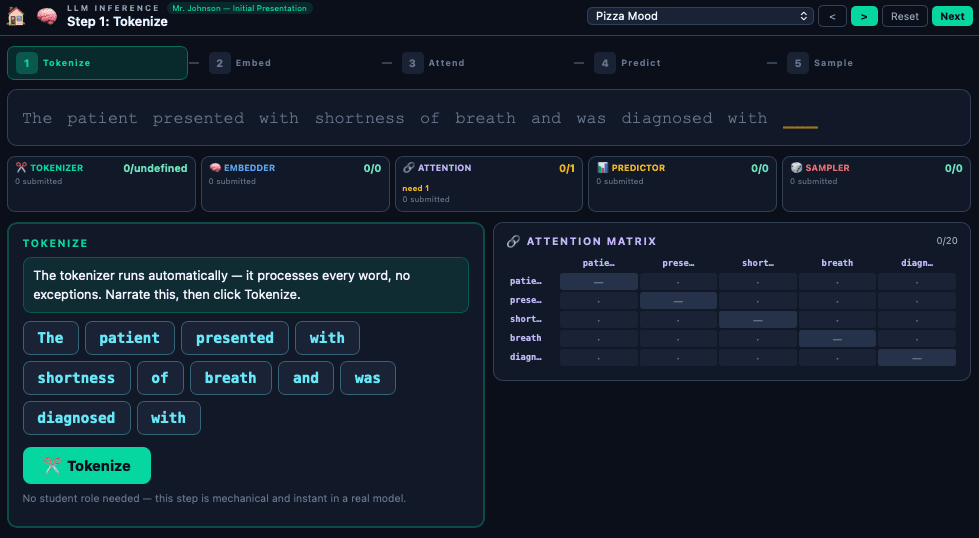
Live AI simulation
A live simulation that turns people into the system, so leaders can see where AI should automate, augment, assist, or escalate.
Why this exists
Most people encounter AI through slides, summaries, or polished outputs detached from the workflow around them.
Participants take on roles inside the system, making model behavior visible, memorable, and discussable.
The lesson is not just what the model can do. It is what authority an organization gives that output once it enters a real process.
The shift
The old paradigm
The executive paradigm
A recommendation often becomes a de facto decision before the business realizes it.
The framework
AI acts on its own where objectives are clear, feedback is fast, and success is measurable.
AI does the heavy lifting while a person shapes, steers, and owns the result.
AI advises and a human still makes the call, especially when context carries weight.
AI hands off the moment signals are weak, stakes are high, or the situation is ambiguous.
Core insight
The same AI response can be trusted or ignored depending on where it appears and whether review and guardrails are visible.
In isolation
In workflow
How it works
Frame the use case, the stakes, and the roles in the room.
Participants join on their phones and see only the information tied to their role.
The room produces an answer together, with constraints, blind spots, and review points made visible.
The facilitator connects what happened in the room to workflow design, trust, and AI adoption.
The live exercise
The room trains a single model on a scenario everyone already understands, then stress-tests it under weak signals, conflicting interpretation, bias, and drift. The closing question is the one that matters: where does human judgment actually earn its keep?
The technical depth track
The executive journey: three modules, one scenario
One model, trained by the room, then trusted with a public warning.
Core mechanics
Participants experience how token-by-token prediction becomes polished language.
Data and behavior
Show how data, repetition, and feedback shape system behavior over time.
Input design
Prompting becomes a lesson in structure, constraints, and task framing.
High-stakes workflows
Plausible output can sound polished and still be dangerous.
Decision oversight
Make visible how review changes both trust and responsibility.
Context retrieval
See what changes when a model is grounded in outside information.
Autonomy
Understand why autonomy raises the stakes for structure, observability, and safety.
Where it leads
The simulation is where leaders discover the decision. The operational question comes next: how do you govern AI systems once those decisions are made? That is a separate layer, with its own lifecycle.
Who it's for
Teach AI behavior in settings where trust, review, and workflow carry real consequences.
Decide where AI should automate, augment, assist, or escalate when the stakes are clinical and the oversight has to be visible.
Give students a more durable way to understand model behavior than passive explanation alone.
Give cross-functional groups a shared way to assign decision rights across AI systems, workflows, and governance.
Credibility
The Human LLM was created to offer a more useful way of learning about AI: one that makes system behavior visible inside workflow instead of treating AI as an abstract black box.
Available for workshops, classrooms, conferences, and team sessions.